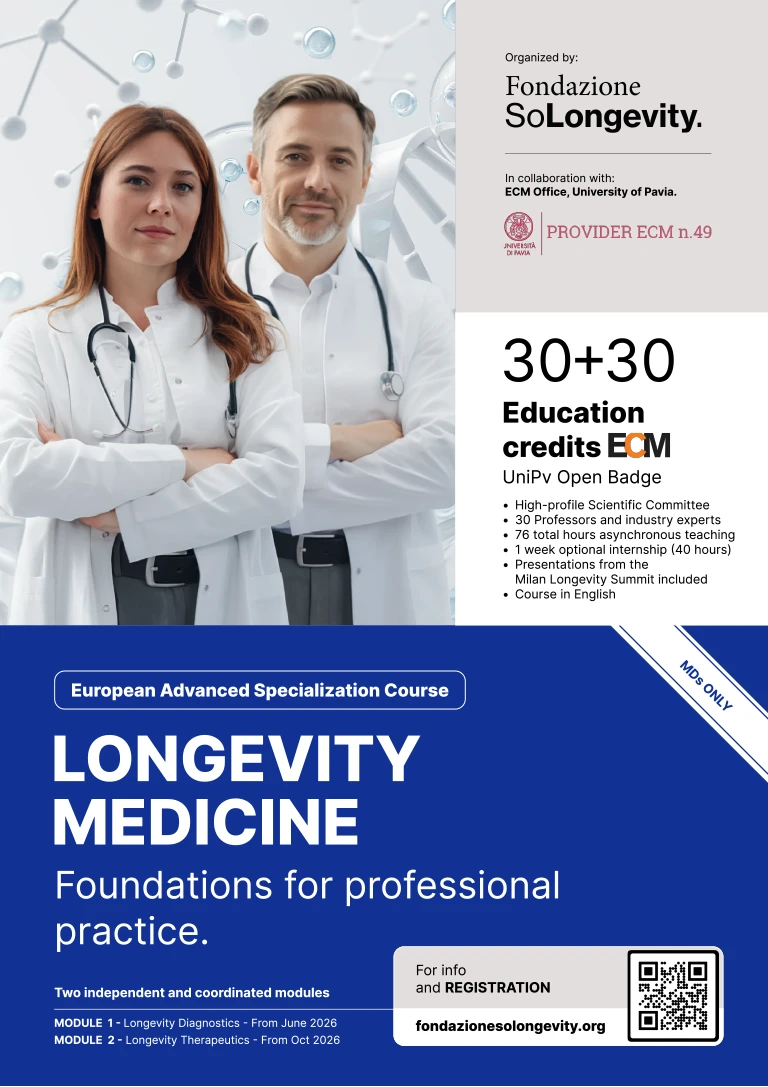
European Advanced Specialization Course
LONGEVITY MEDICINE
Table of Contents
Foundations for professional practice.
[MDs ONLY]
The Specialization Course in Longevity Medicine is a premier training program, specifically designed for medical professionals who wish to integrate the most advanced knowledge of biology and clinical practice to promote healthy longevity into their daily practice. The goal is to qualify the professional figure of the Longevity MD Specialist by providing comprehensive diagnostic and therapeutic training, focused on early diagnosis, prevention of chronic non-communicable diseases, treatment of processes related to cellular senescence, and the restoration of the patient’s biological balance and physiological capabilities.
The course is divided into two sequential and independent modules, each of which culminates in a final exam that guarantees the acquisition of training credits. Access to Module 2 (Therapies) is strictly linked to passing the Module 1 (Diagnostics) exam, thus ensuring rigorous educational progression based on solid scientific foundations.
Organized by:
In collaboration with:
ECM Office, University of Pavia.
30+30
Education credits ECM
UniPv Open Badge
High-profile Scientific Committee
30 Professors and industry experts
160 total hours asynchronous teaching
Course in English
Two independent and coordinated modules
Module 1: Longevity Medicine Diagnostics
This module is entirely dedicated to exploring the biological mechanisms of aging and acquiring the skills necessary for a thorough and personalized diagnostic assessment of the patient. It provides all the skills needed for the clinical use of precision medicine methods in assessing aging hallmarks, individual risk stratification, and patient physiological and cognitive reserve.
Table of Contents Module 1
| Chapters | Lesson Title | Lesson Hours (42 total hours) | Lecturers |
| 1. Introduction to Longevity Medicine | 1 | ||
| Longevity Medicine: from Fundamental Biology to Clinical Practice | 1 | Alberto Beretta | |
| 2. Biological Foundations of Aging | 4 | ||
| The Hallmarks of Aging | 1 | Pedro Bastos | |
| The Metabolic Pillars of Longevity. Focus on alpha Klotho | 1 | Fabio Sallustio | |
| Genetics of Longevity | 1 | Paolo Garagnani | |
| Immunosenescence and Its Assessments: New Paradigms | 1 | Andrea Cossarizza | |
| 3. Human Physiology and Aging | 17 | ||
| Cardiovascular Pathophysiology and Longevity Medicine | 2 | Nicola Triglione | |
| Early Diagnosis of Cognitive Decline and Age-related Disorders (the role of neuroimaging) | 1 | Daniela Perani | |
| MRI and PET Neuroimaging in the diagnosis and prognosis of neurodegenerative disease | 1 | ||
| Physiology of Strength and Muscle Tissue: What Happens as We Age and How to Prevent It | 2 | Giuseppe Coratella | |
| Physiopathology of the Adipose Organ | 2 | Saverio Cinti | |
| Respiratory Physiology and its Alterations with Aging | 1 | Nicola Scicolone | |
| Age-Related Changes in the Female Reproductive System and an In-Depth Look at Menopause | 2 | ||
| Age-Related Physiological Changes in the Male Reproductive System | 1 | Alberto Gheza | |
| Hormone Homeostasis and Aging | 1 | Mario Rotondi | |
| Thyroid Hormones | 1 | ||
| Markers of Skin Aging | 1 | Guida Stefania | |
| The Eye: How to Keep it Healthy Over Time | 1 | Barabino Stefano | |
| Impact of Aging on Cognitive Domains (Complex Attention, Executive Function, Learning and Memory, Language, Perceptual–Motor Function, and Social Cognition) | 1 | Francesca Baglio | |
| 4. Biologic Markers of Aging | 9 | ||
| Epigenetics and Epigenomics: from Basic Concepts to the Longevity Frontiers | 1 | Davide Cacchiarelli | |
| Epigenetics: Study of Epigenetic Modifications and Their Role in Aging | 1 | Paolo Garagnani | |
| The Role of Proteomics in Precision Medicine | 1 | Austin Argentieri | |
| Microbiome: Assessment of the Composition of the Microbiota and Its Influence on Health and Longevity | 2 | Enrico Bevacqua | |
| Blood Chemistry: “non-canonical” Parameters and Interpretative Ranges | 1 | Giuseppe Cardillo | |
| Immunosenescence and Its Assessments: New Paradigms | 1 | Andrea Cossarizza | |
| Inflammaging Evaluation | 1 | Claudio Franceschi | |
| Techniques for Evaluating Mitochondrial Activity and Their Clinical Applications | 1 | Chiara Macchi | |
| 5. Physiologic Markers of Aging | 9 | ||
| CardioPulmonary Exercise Testing and Longevity (CPET) | 2 | Marco Vecchiato | |
| Electrocardiogram (ECG) and Heart Rate Variability (HRV) | 2 | Stefano Palermi | |
| Body Composition Analysis: Assessment of Muscle, Fat and Bone Mass | 1 | Alberto Cerasari | |
| Neuropsychological Assessment and Setting Up the Cognitive Stimulation Plan | 1 | Giuseppe Iannoccari | |
| Neuropsychological Aspects of Learning in Brain Aging and Intervention Methodologies | 1 | ||
| The Contribution of Neuroimaging to the Study of Brain Plasticity | 1 | Daniela Perani | |
| Wearable Biomarkers and Longevity Medicine | 1 | Nicola Triglione | |
| 6. Advanced Imaging Technologies | Magnetic Resonance Imaging (MRI), Ultrasound, Computed Tomography (CT) scan | 2 |
Module 2: Longevity Medicine Therapies
Reserved for physicians who have completed Module 1, this course focuses on therapeutic strategies and intervention techniques to modulate the aging process, influence individual risk profiles, and promote the enhancement of the patient’s physiological and cognitive reserve.
You can only enrol on Module 2 if you have first enrolled on and attended Module 1
Table of Contents Module 2
| Chapter | Subchapter | Lesson Titles | Lesson Hours (34 total hours) | Lecturers |
| 1. Longevity Medicine Interventions | ||||
| Nutrition Strategies | 9 | |||
| From Personalized Nutrition to Precision Nutrition | 1 | Hellas Cena | ||
| Precision Nutrition, Omics and Healthy Ageing: from Biological Variability to Personalised Prevention | 2 |
Rachele De Giuseppe
|
||
| Caloric Restriction and Fasting in Healthy Ageing – From Molecular Mechanisms to Clinical Translation | 1 | |||
| Nutritional Requirements and Supplementation in Ageing Populations | 1 | Maria Vittoria Conti | ||
| Over-nutrition and Under-nutrition in Old Age | 1 |
Nagaia Madini
|
||
| Nutrition and Supplementation in Obesity | 1 | |||
| Nutrition and Supplementation in Cardiovascular Rist | 1 | |||
| Nutrition and Supplementation in Neurodegenerative Risk | 1 | Cecilia Ricciardi Rizzo | ||
| Physical, Breathing and Sleeping Education | 4 | |||
| Exercise as a Pillar of Longevity | 1 |
Silvano Zanuso
|
||
| The Basics of Aerobic and Resistance Training | 1 | |||
| Respiratory Capacity Re-Education Techniques and Protocols to Improve Ventilatory Efficiency | 1 | Dario Morelli | ||
| Sleep as a Pillar of Longevity: Mechanisms Linking Sleep Physiology to Healthy Aging | 1 | Ugo Faraguna | ||
| Longevity Pharmacology | 5 | |||
| Hormone Replacement Therapy in Men | 1 | Mario Rotondi | ||
| Hormone Replacement and Other Therapies for Menopause Management | 1 | Raffaela Di Pace | ||
| Pharmacologic Weapons to Maintain Healthspan: Past, Present and Future | 2 | Maria Pia Abbracchio | ||
| Molecules of the Future | 1 | Valerio Solari | ||
| Regenerative Medicine | 3 | |||
| Therapeutic Apheresis and Extracorporeal Photopheresis | 1 | Maria Stigliano | ||
| Mesenchimal Stem Cells (MSC): from Niche Biology to Precision Regenerative Medicine | 1 |
Eugenio Caradonna
|
||
| Platelet Rich Plasma (PRP): a journey toward Precision Regenerative Medicine precision regenerative medicine |
1 | |||
| Bio-Hacking Solutions and Applications | 5 | |||
| PhotoBioModulation |
2
|
Paolo Capodaglio
|
||
| Whole Body Cryostimulation | ||||
| Hyperbaric Oxygen Therapy | ||||
| Ozone Therapy: Mechanisms of Action and Controversial Applications | 1 | Claudio Tavera | ||
| Infusion Therapies: Use of Nutrients and Drugs to Optimize Health | 1 | Roberta Costanzo | ||
| Transcranial Magnetic Stimulation | 1 | Livio Luzi | ||
| 2. New Clinical Tools for Longevity Medicine | 4 | |||
| Longevity Leadership: from Biological Age to Organizational Resilience | 1 | Virginia Boccardi | ||
| Artificial Intelligence in Clinical Medicine | 2 | Luca Bianchi | ||
| Clinical AI workstreams – Longevity and Disease Progression | 1 | |||
| 3. Professional Paradigm Shift | 2 | |||
| Anamnesis and Ethical-Professional Approach in Longevity Medicine | 1 | Alberto Cerasari | ||
| Changing Habits for Longevity | 1 | Filippo Ongaro | ||
| 4. Ethical and Social Aspects of Longevity Medicine | Overview of the ethical and legal constraints and challenges associated with accessing data necessary for clinical use (i.e. such as genomic data) | 2 |
Training Credits and Requirements
Successful completion of each module will grant students 30 education training credits (CFU/ECTS), conditional on passing each module exam, essential for professional advancement and ongoing training as a doctor.
the training credit certification platform is the one managed and administered by the ECM Office of the University of Pavia,
The sequential nature of the modules ensures that each participant has a complete diagnostic background before tackling the most advanced therapeutic strategies.
The requirements for students to enroll are as follows:
Single-Cycle Master’s Degree in Medicine and Surgery (LM-41) all disciplines
How to participate and how to deliver the course
The course will be delivered in English and in asynchronous mode using the ECM platform https://www.ecmunipv.it/
Student access is managed via personal, non-transferable credentials provided at the time of registration.
Each course includes:
- asynchronous video lesson
- presentation deck of the lesson
- exercise
At the end of each training module, students take a competences skills certification exam delivered through the platform. Successful completion of the exam allows for the issuance of a certificate of training credits.
The Longevity MD Specialist qualification requires the completion of both training modules and passing the related exams.
Without prejudice to the student’s freedom to concentrate their use of the course according to their weekly availability, the estimated duration of the two modules is as follows:
- Module 1 Diagnostics of Longevity Medicine: 56 hours in total between teaching and exams for an estimated weekly commitment of 19 weeks
- Module 2 Longevity Medicine Therapies: 44 hours in total between teaching and exams for an estimated weekly commitment of 15 weeks
- Clinical Intership module (optional): 40 hours of clinical practice at SoLongevity HealthcentersMatt srl facilities, for a continuous one-week period of on-site attendance. Due to high demand for the course and the internship, places for 2027 are now full. New applications will be placed on a waiting list for 2028 or for any places that may become available during 2027.
Registration fee and organizational secretariat
The registration fee for
- Module 1 “Diagnostics of Longevity Medicine” is €2,500
- Module 2 “Therapies of Longevity Medicine” is €2,500. Enrol on Module 2 if you have first enrolled on and attended Module 1
Registering for both modules at the same time entitles you to a 10% discount overall: instead of €5,000, the total cost is €4,500.
The payment methods are structured differently depending on the student’s training selection.
If you enroll in Module 1 or Module 2 only, payment for the module (€2,500) must be made before the module starts. Access codes for the training platform will be sent afterwards.
If you enroll in both modules (Module 1 + Module 2) at the same time, the following applies:
- Enrolling in both modules together gives you an overall 10% discount: instead of €5,000, the total cost is €4,500.
- Payment of the full amount, online or by bank transfer, in a single installment with an additional 5% discount!
- In alternative, payment in three monthly installments, with no extra costs or interest.
Additional 5% discount!!
The discount for purchasing both modules is reserved for the first doctors to enroll in the Longevity Medicine Course — meaning a 10% discount on the full course, available only to physicians who enroll during the launch period. Right now!!
In addition to the special package price for Modules 1 and 2, we want to offer you a further benefit: if you pay for both modules together in a single installment, you’ll receive an additional 5% discount!
Alternatively, you can pay in three monthly installments, with no extra costs or interest.
Option
Standard Price
Special Price
NOW!!
M1 & M2 FEE
in a single payment (-5%)
Module 1
EUR 2.500
Module 2
EUR 2.500
MODULES 1 & 2
EUR 5.000
EUR 4.500
EUR 4.275
Option
Standard Price
Special Price
NOW!!
M1 & M2 FEE
in a single payment (-5%)
Module 1
EUR 2.500
Module 2
EUR 2.500
MODULES 1 & 2
EUR 5.000
EUR 4.500
EUR 4.275
Payment methods
Payment is made online and at the same time as signing the enrolment contract for the course. You can pay using major credit cards.
If you prefer to pay by bank transfer, please contact the course administration in advance by emailing academy@fondazionesolongevity.org.
Course Agreement
View the Course Agreement
Download Agreement (PDF format)

MDs in specially training
Are you a young doctor in specialty training? There’s an offer for you!
If you’re a physician currently enrolled in a specialty training programme (residency), there’s a special offer for you! When you complete your application (sign up here!), tick the box for ‘Doctors in specialist training’, you’ll receive the details of the offer reserved for young doctors in training. To ensure you are eligible for the special offer, we will ask you to provide us with documentation relating to your current specialisation programme.
Payment certificate
Fondazione SoLongevity ETS, as a non-profit Social Promotion Association (Associazione di Promozione Sociale – APS), is not subject to VAT and therefore delivers its training courses without the obligation to issue an invoice.
In place of an invoice, the Foundation issues a payment receipt together with a payment certificate. For the purpose of documenting the expense — including any cost deduction the Participant may be entitled to claim — these documents constitute valid proof of payment.
Where payment is made by a corporate or other collective entity (e.g. a company), the paying entity must in any case specify the name of the natural person who will attend the training course.
FAQ
Who is the course intended for?
Is the course theoretical or practical?
How is the course delivered?
Is it suitable for qualified MDs already working full-time?
What professional profile does the course aim to train?
What materials does the participant retain after the course?
What certifications and recognitions are issued on completion?
How many training credits are awarded on completion?
Each module of the course carries 30 ECM credits, awarded upon successful completion of the final assessment test.
Is there ongoing training and engagement beyond the online lessons?
Is there interaction with the faculty?
For how long will I be able to access the course video lessons?
Can I enrol in a single module?
Is the clinical internship mandatory?
What payment methods are available for enrollment?
Organized by:
In collaboration with:
ECM Office, University of Pavia.
University of Pavia is one of the world’s oldest academic institutions, a vibrant city-campus, and a top-tier Italian research hub. Officially founded in 1361, it hosts over 26,000 students across 18 departments and offers over 80 degree courses, including numerous online programs.
30+30
Education credits ECM
UniPv Open Badge
High-profile Scientific Committee
30 Professors and industry experts
160 total hours asynchronous teaching
Course in English